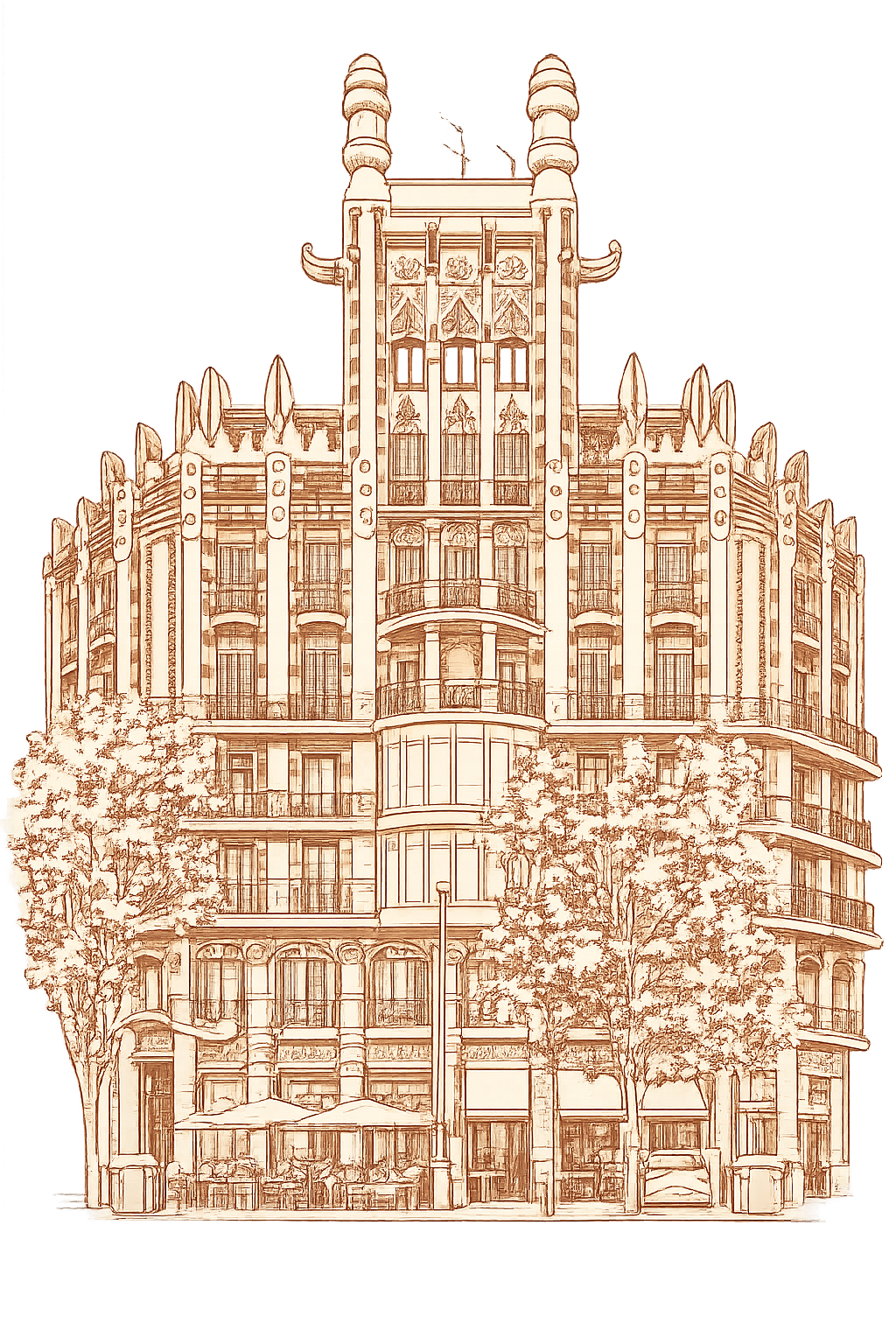
The Other Eixample
The Eixample Esquerra and the Eixample Dreta are, physically, the same neighbourhood divided by the Passeig de Gràcia. The grid is identical. The building type is the same. The street widths are the same. The quality of the morning light, the density of the commercial offer, the proximity to the metro — all the same. The difference is the address, and the address commands a premium of roughly fifteen to twenty per cent that is, on close examination, difficult to justify on any grounds other than perception.
This is not a new observation. It has been made by buyers, agents, and analysts for as long as the two halves of the Eixample have been compared. What is interesting is that the gap persists. The Esquerra has been 'about to close the gap' for at least two decades, and it has not closed it. The reasons are partly psychological — the Dreta has the landmarks, the Dreta has the address — and partly structural: the concentration of luxury retail and international buyers on the Dreta creates a self-reinforcing dynamic that is difficult to disrupt.
Architecture and Character
The Esquerra has its own architectural landmarks, and they are worth taking seriously. The Hospital de la Santa Creu i Sant Pau — a UNESCO World Heritage Site designed by Domènech i Montaner and built between 1902 and 1930 — is one of the most extraordinary buildings in Barcelona and one of the most undervisited. The complex consists of forty-eight pavilions connected by underground passages, set in gardens, and decorated with mosaics, stained glass, and sculpture to a degree that makes the Sagrada Família's decoration look restrained. It is a masterwork of Modernista architecture and it is, on most days, significantly less crowded than the buildings on the Dreta.
The Esquerra also contains the Universitat de Barcelona — the main building, on the Gran Via, is a neoclassical structure of considerable quality — and the Escola Industrial, a converted textile factory that is one of the more quietly impressive pieces of industrial architecture in the city. The neighbourhood's character is slightly more residential and slightly less commercial than the Dreta's, which is, for many buyers, a recommendation rather than a limitation.
Daily Life
The commercial offer is strong. Carrer del Consell de Cent, Carrer de Muntaner, and the streets around the Universitat sustain a dense network of restaurants, bars, and independent shops that are oriented toward residents rather than tourists. The Mercat de Sant Antoni — recently restored after a decade-long renovation — is one of the finest market buildings in Barcelona and one of the most genuinely useful: the Sunday book market that occupies the perimeter is a Barcelona institution.
The neighbourhood's gay quarter — centred on Carrer del Consell de Cent and Carrer de Muntaner — is one of the most established in Europe and contributes to a social atmosphere that is open, cosmopolitan, and consistently interesting. This is not a neighbourhood that performs tolerance; it is a neighbourhood that has been genuinely diverse for long enough that diversity is simply its character.
The Property Market
For buyers, the arithmetic is straightforward. The Esquerra offers the same physical quality as the Dreta at a lower price. The trade-off is the address and the concentration of landmark buildings. For buyers who are purchasing primarily for their own use and who are indifferent to the status of the address, the Esquerra is the more rational choice. For buyers who are purchasing as an investment and who are focused on liquidity and resale value, the Dreta's premium is more defensible.
The neighbourhood that is most frequently compared to the Eixample Dreta is, inevitably, the Eixample Dreta itself — buyers who have been priced out, or who have decided that the premium is not justified, arrive here and find something that is, in most material respects, the same neighbourhood at a different price point. The grid is the same. The building type is the same. The quality of daily life — the markets, the restaurants, the parks, the metro — is the same. The difference is the address, the density of landmark buildings, and the price.