The Overlooked Neighbourhood
Sants is the largest neighbourhood in Barcelona by population and one of the least discussed in property circles. This is an oversight worth correcting. The neighbourhood has everything that makes a city neighbourhood function well, and it has it without the self-consciousness that afflicts areas that have recently been discovered and are still adjusting to the attention.
Connectivity
The neighbourhood's practical foundation is Sants station — the city's principal rail hub, connecting to the airport in twenty minutes, to Madrid in two and a half hours on the AVE, and to the rest of Spain and Europe beyond. The station sits at the centre of the neighbourhood and gives it a connectivity that is simply unmatched. For buyers who travel professionally, who maintain connections with other cities, or who value the optionality that good rail connections provide, this single fact repositions Sants relative to more fashionable alternatives. The Eixample is well served by metro; Sants is well served by everything.
Daily Life
The neighbourhood's working-class origins are still present and, for buyers who value authenticity over curation, that is not a problem but a quality. Carrer de Sants — the principal commercial street, running the length of the neighbourhood — is a genuine high street: not a gallery of independent lifestyle concepts but a street of butchers, hardware shops, pharmacies, the kind of businesses that sustain daily life rather than photograph it. The Mercat de Sants, a covered market in a building that is itself worth attention, serves the neighbourhood with produce that is seriously good and at prices that reflect local rather than tourist demand.
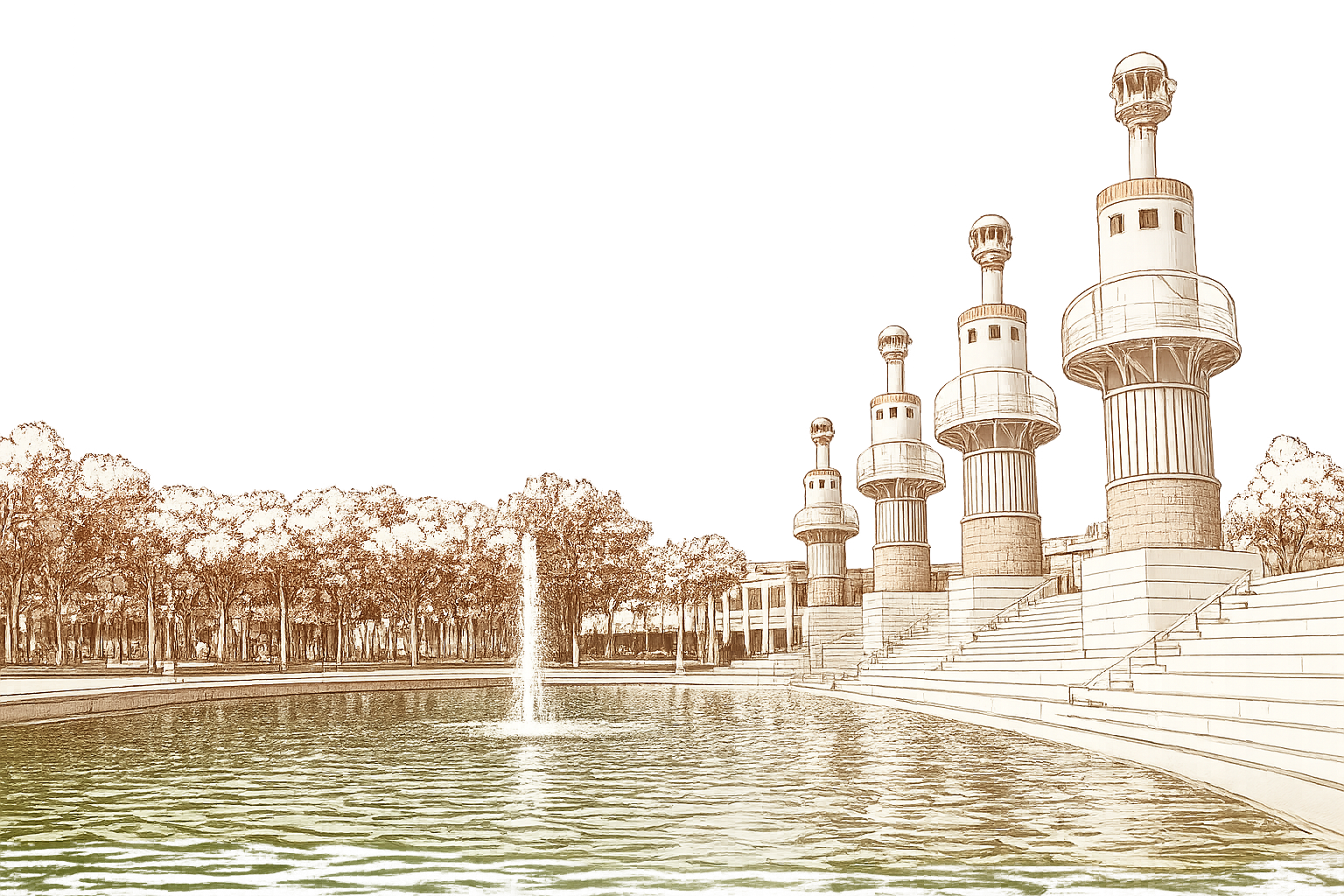
The Parc de l'Espanya Industrial is the neighbourhood's most distinctive public space and one of the more unusual parks in Barcelona. Built in 1985 on the site of a former textile factory, it organises itself around a central lake presided over by a neoclassical dragon sculpture — an iron figure by Andrès Nagel that has become one of the neighbourhood's defining landmarks. Flanking the lake is a row of ten modernist watchtower columns designed by Viaplana and Piñón that serve as viewing platforms and give the park its most distinctive silhouette. Stepped terraces function as an amphitheatre; water features cross the paths. It is not conventionally beautiful, and it was not designed to be. It is a piece of postmodern urban design — self-aware, slightly theatrical, and ultimately good-humoured — that has aged better than most of its contemporaries.
The neighbourhood's food and cultural offer is less celebrated than the Eixample's or Poble Sec's but consistently solid. Carrer de Sants and the streets around the market sustain a dense network of restaurants, bars, and tapas places that are oriented entirely toward the people who live here. The quality of casual eating — good vermouth, honest grilled fish, the kind of tortilla that is only made well in places that make it for regulars — is high. The neighbourhood also has one of the oldest cultural institutions in Barcelona: the Ateneu de Sants, a civic and cultural society founded in 1877 that continues to function as a centre for theatre, music, and political discussion.
The Property Market
Property in Sants is valued at a meaningful discount to the Eixample and Gràcia, and the discount reflects perception rather than quality. The buildings are solid — the apartment stock is primarily from the mid-twentieth century and is well-constructed if less architecturally distinguished than the Eixample's — the apartments are well-proportioned, and the neighbourhood functions. For buyers who are purchasing primarily as an investment, the combination of accessible entry points, excellent transport connectivity, and a resident population of substantial and stable size creates a rental yield proposition that is among the strongest in Barcelona. For buyers who want to maximise space for their budget, the arithmetic is equally clear.
The neighbourhood is well connected in every direction: three metro lines, the FGC, the principal rail station, and the airport bus. It is, by any objective measure, the best-connected neighbourhood in Barcelona. That connectivity is not fully reflected in property values in the way that comparable factors are elsewhere in the city. Sants deserves serious consideration.